Google Pay: Redesigning Group Expense Splits to Reduce Social Friction

Google Pay: Redesigning Group Expense Splits to Reduce Social Friction

Google Pay: Redesigning Group Expense Splits to Reduce Social Friction

Reducing reminder anxiety and off-platform settlements by redesigning intent, timing, and accountability in shared expenses

Reducing reminder anxiety and off-platform settlements by redesigning intent, timing, and accountability in shared expenses

Reducing reminder anxiety and off-platform settlements by redesigning intent, timing, and accountability in shared expenses

This project explores how shared expense tools can move beyond mathematical accuracy to address the social discomfort that causes delayed payments, avoidance, and off-platform settlements.

This project explores how shared expense tools can move beyond mathematical accuracy to address the social discomfort that causes delayed payments, avoidance, and off-platform settlements.

This project explores how shared expense tools can move beyond mathematical accuracy to address the social discomfort that causes delayed payments, avoidance, and off-platform settlements.

Product

Google Pay

Role

Product designer

Timeline

2 Days

Scope

End-to-end redesign of split creation, expense tracking, reminders, and settlement flows

Problem

Problem

Problem

The awkwardness of asking (and being asked)

The awkwardness of asking (and being asked)

The awkwardness of asking (and being asked)

People don’t delay settling expenses because of money; they delay because asking friends to pay feels uncomfortable. Most tools optimize for accuracy, not relationships, pushing users toward avoidance or off-platform settlements.

People don’t delay settling expenses because of money; they delay because asking friends to pay feels uncomfortable. Most tools optimize for accuracy, not relationships, pushing users toward avoidance or off-platform settlements.

This opened an opportunity to reduce social pressure while keeping shared payments inside the system.

This opened an opportunity to reduce social pressure while keeping shared payments inside the system.

This opened an opportunity to reduce social pressure while keeping shared payments inside the system.

Research

Research

Research

To understand why shared expenses break down socially, I conducted primary & secondary qualitative research through user testing & using AI-assisted synthesis (Perplexity) across:

  • Phone-call interviews

  • Reddit discussions on bill splitting and group payments

  • Public conversations on X (Twitter)

  • Long-form personal accounts describing money-related discomfort

AI was used to aggregate recurring sentiments and validate patterns — not to generate insights.

Common pain points

Common pain points

Common pain points

Avoidance over refusal

Users delay settling not due to money, but discomfort around reminders.

Small amounts feel risky

Minor expenses are skipped to avoid appearing petty, despite emotional weight.

Reminders strain relationships

Friend-led reminders feel personal, even when system-generated.

Partial payments leak off-platform

Inflexible flows push users to cash or other apps.

Product goals & success metrics

Concept metrics linking social friction to measurable outcomes

Increase on-platform settlement

  • % of group expenses settled within 7 days

  • Goal: +10–15%

Reduce off-platform leakage

  • % of settlements completed via cash or other apps

  • Goal: −15–20%

Increase expense logging

  • Avg. expenses logged per group/month

  • Proxy: low-value (<₹100) expenses logged

  • Goal: +15% total, +20% low-value

Solution

Solution

Solution

Designing for intent, timing, and system-led accountability

Designing for intent, timing, and system-led accountability

Designing for intent, timing, and system-led accountability

Instead of treating shared expenses as immediate payment requests, the redesign reframes them as shared financial states — where intent is clear, pressure is reduced, and the system handles follow-up.

The solution focuses on three core ideas

The solution focuses on three core ideas

The solution focuses on three core ideas

Make intent explicit

Let the reminders feel like system generated

Track progress without blame

Key Design Decisions

Key Design Decisions

Key Design Decisions

  1. Intent-based split creation

  1. Intent-based split creation

  1. Intent-based split creation

When logging an expense, users

explicitly select intent:

When logging an expense, users explicitly select intent:

When logging an expense, users explicitly select intent:

When logging an expense, users explicitly select intent:

Covering for now

Settle later

Treat / Gift

This removes ambiguity and reduces anxiety without enforcing immediate repayment.

  1. Rounding to handle small amounts

  1. Rounding to handle small amounts

  1. Rounding to handle small amounts

Splits are rounded by default, absorbing minor differences.

Splits are rounded by default, absorbing minor differences.

Splits are rounded by default, absorbing minor differences.

This allows users to log all expenses without appearing overly transactional, addressing hesitation around “penny amounts” without introducing complex mechanics.

  1. Status-driven expense cards

  1. Status-driven expense cards

  1. Status-driven expense cards

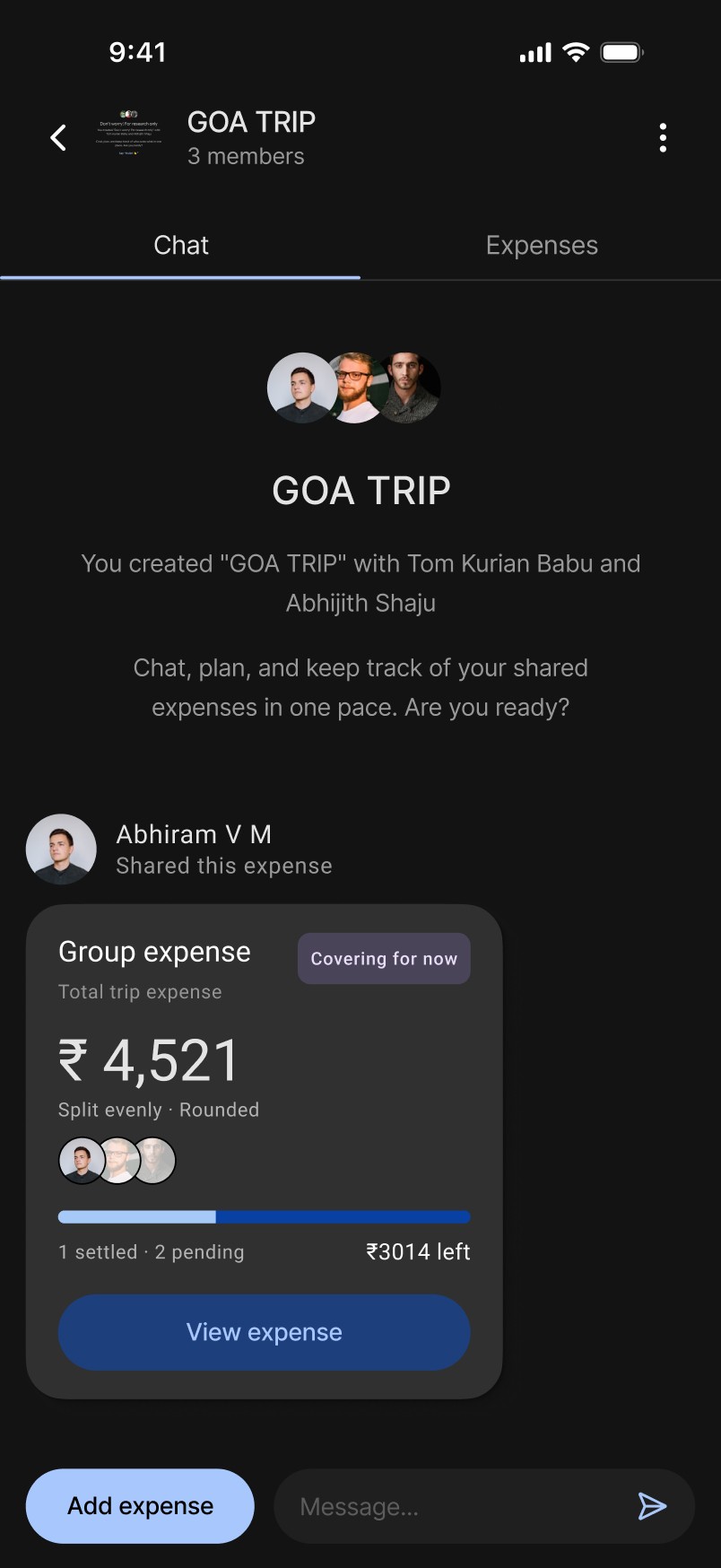
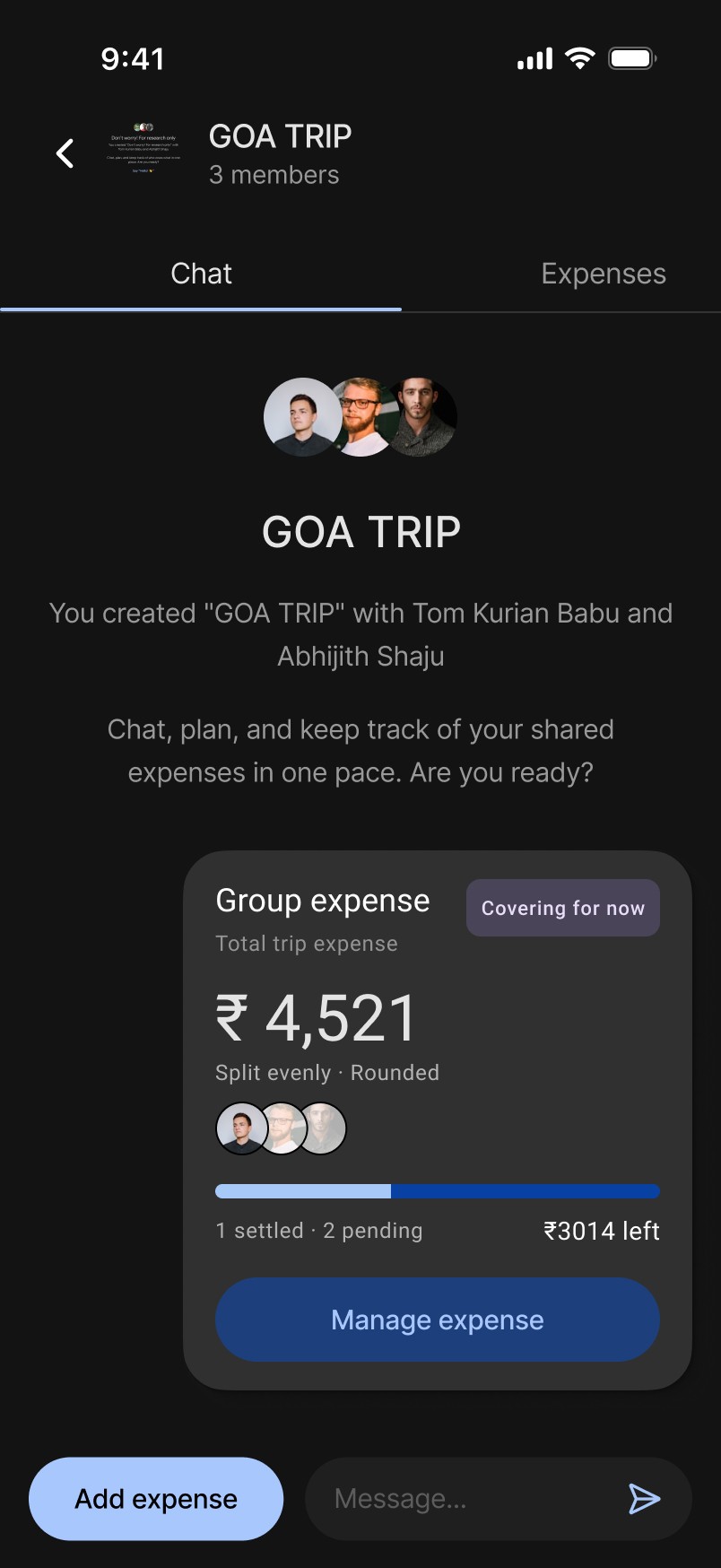
Expense cards communicate context and progress, not demand.

Expense cards communicate context and progress, not demand.

Expense cards communicate context and progress, not demand.

“Group expense added” replaces “Split request”

Collective progress is shown instead of individual callouts

No immediate payment CTA

This shifts the tone from asking for money to tracking shared context.
Sender's View

Sender's View

Sender's View

Sender's View

Sender's View

Receiver's View

Receiver's View

Receiver's View

Receiver's View

Receiver's View

  1. Soft, user-triggered updates (not hard reminders)

  1. Soft, user-triggered updates (not hard reminders)

  1. Soft, user-triggered updates (not hard reminders)

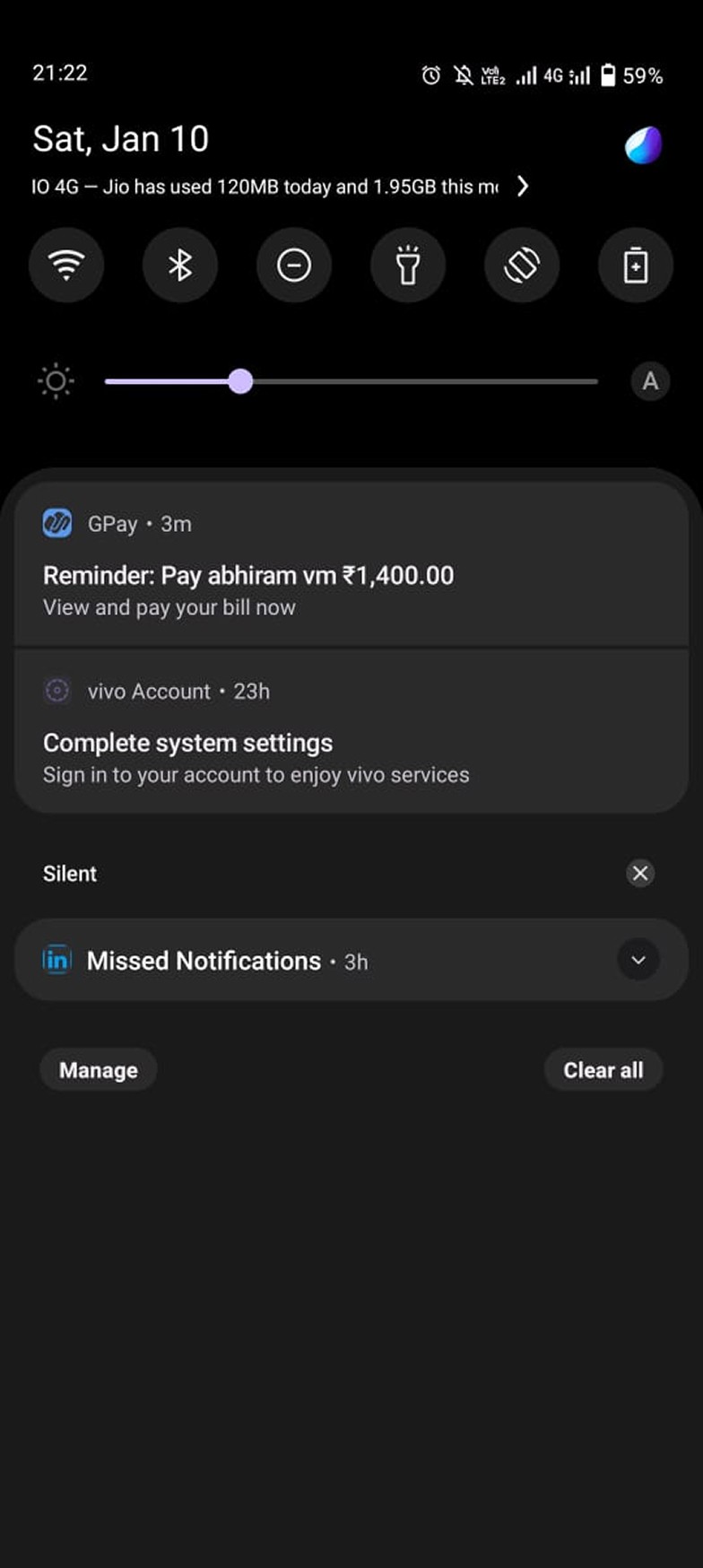
Users can trigger an “Update expense status” action.

Users can trigger an “Update expense status” action.

Users can trigger an “Update expense status” action.

Notifications appear system-initiated

No names, no “you owe”

No urgency language

This preserves accountability while removing interpersonal pressure.
Before

Before

Before

Before

Before

After

After

After

After

After

Constraints & Future Scope

Constraints & Future Scope

Constraints & Future Scope

Designing within real system limits

Designing within real system limits

Designing within real system limits

Current UPI flows restrict manual amount editing during payment. The design surfaces partial settlement intent clearly within this constraint, while identifying an opportunity for future enhancement.

Future opportunity

Future opportunity

Future opportunity

Editable settlement amounts in UPI flows

Auto-reconciliation of remaining balances

This would reduce off-platform leakage and better match real payment behavior.

Impact

Impact

Impact

Designing for relationships, not just receipts

Designing for relationships, not just receipts

Designing for relationships, not just receipts

Expected outcomes

Expected outcomes

Expected outcomes

Higher expense logging rates

Reduced reminder fatigue

Faster settlement completion

Increased in-app transaction retention

By shifting responsibility for awkward moments from users to the system, shared expenses can be resolved naturally — without damaging relationships.

Closing Note

Closing Note

Closing Note

Shared expenses aren’t a financial problem — they’re a social coordination problem.

Shared expenses aren’t a financial problem — they’re a social coordination problem.

Shared expenses aren’t a financial problem — they’re a social coordination problem.

This redesign shows how thoughtful product decisions around intent, timing, and tone can transform a routine money flow into a calmer, more human experience.

Let's have a chat

Let's have a chat

Let's have a chat

Say Hi

Say Hi

Say Hi

Say Hi

Say Hi

Say Hi

Say Hi

Say Hi

Say Hi

Say Hi